Strategy
Awareness of Risks and Opportunities
The Group specifies “Green” as one of the established tasks of “Materiality,”and it takes on climate change as an urgent issue to be resolved.
There are 2 types of risks related to climate change: transition risks arising from moving to a low-carbon economy and physical risks where climate change has a direct impact on wealth, etc. The transition risks are classified into 1) policy and legal risks as a consequence of tightened regulations, 2) technology risks to be affected by new technologies, 3) market risks, and 4) reputation risks. The physical risks are classified into acute risks exemplified by typhoons or floods, and chronic risks which may have a mid- and long-term impact, like rising temperature or sea level rise. On the other hand, initiatives on climate change could present us opportunities for increasing revenue through sales of new products.
The Group is aware that when such risks and opportunities actually emerge, they may affect its financial standing and performance, depending on their nature. Therefore, the Group identifies specific risks and opportunities that climate change may bring about and may affect the Group’s business by sometime around 2050. For the said purpose, we are evaluating the Group’s resilience through a scenario analysis, etc.
The Group has therefore determined response policies based on the identification of risks and opportunities in which climate change may have an impact on the Group’s business, and is implementing initiatives to enhance resilience against climate change.
Examples of climate-related risks
| Risks |
Expected impact |
Time frame |
Category |
| Risk to Be Triggered by Transitions |
Policy/
Regulatory Changes |
The Group may suffer increased operating costs if the government tightens CO2 emission reduction requirements or increases the related regulatory constraints. |
Mid- to long-term |
Policy and
regulatory risk |
| Technology |
The Group’s revenue may decrease if it cannot offer products and services that align with the changing industrial structure and customer needs as decarbonization technology advances. |
Mid- to long-term |
Operational risk |
| Impact on Market |
The Group’s trading assets may suffer a loss due to sudden market fluctuations triggered by policy changes or the tightening of regulations associated with the transition to a decarbonized society. |
Short- mid- to long-term |
Market risk |
| Reputation |
The Group’s reputation may be damaged if it fails to meet the stakeholders’ expectations on its climate change actions and related disclosures. |
Short- mid- to long-term |
Reputation risk |
| Physical Risk to Be Triggered by Natural Disaster |
Acute/chronic |
The Group’s business performance may be adversely affected by the damage to the Group’s assets due to abnormal weather such as massive typhoons and heavy rainfalls, the increased costs from the interrupted operations, the absence of employees from work affected by the disaster, and other natural causes. |
Short- mid- to long-term |
Operational risk |
| The Group may lose earning opportunities if abnormal weather such as massive typhoons and heavy rainfalls causes casualty or property damage to the Group’s clients. |
Short- mid- to long-term |
Credit risk |
| Collateral value in the loan business may decline, and the collectability of receivables may be impaired due to abnormal weather such as massive typhoons and heavy rainfalls. |
Short- mid- to long-term |
Market risk |
* Short-term: 3 to 5 years; Mid-term: 5 to 10 years; and Long-term: 10 to 30 years
Examples of climate-related opportunities
| Opportunities |
Time frame |
| Cut energy costs by implementing energy-saving initiatives |
Short- mid- to long-term |
| Increase underwriting of funding for initiatives toward the transition to a decarbonized society |
Short- mid- to long-term |
| Increase investment opportunities in new industries and corporations that contribute to the transition to a decarbonized society |
Short- mid- to long-term |
| Expand business opportunities by improving reputation through initiatives to address climate change |
Short- mid- to long-term |
Scenario Analysis
Under the scenarios published by the Network for Greening the Financial System (NGFS), the Group conducted quantitative and qualitative analyses and assessments of the impact on the Group’s finances (costs and revenues) based on the following three scenarios: Net Zero 2050, which may minimize both transition and physical risks; Delayed Transition, which may cause maximum transition risk; and Current Policies, which may cause maximum physical risk.
As a result, it was found that costs may increase by approximately 100 million yen annually if we use renewable energy and adopt mitigation measures such as the introduction of zero-emission cars, mostly associated with Tokai Tokyo Securities’ company cars. It was also revealed that heavy rains and flood disasters due to abnormal weather may cause physical damage to some of the Group’s sales offices.
As a result of a comprehensive evaluation of the impact on the Group’s entire business, it concluded that the impact on its finances is limited in scope, although with a certain level of risks remaining.
Nevertheless, the Group reaffirmed the possibility of expanding business opportunities, anticipating the growth of future investment needs in the green sector. Going forward, the Group will continue upgrading the level of its analyses and implement its initiatives to cope with different regulatory moves, one relaxed and the other rigorous, which incur high costs.
Scenario Analysis Overview
Climate change scenario
(NGFS version 4) |
Net Zero 2050 |
Delayed Transition |
Current Policies |
| Scenario overview |
- Limit the world’s temperature rise to 1.5°C by strict emission reduction measures and innovations
- Aim to bring CO2 emissions in the world, including Japan, to net zero by 2050
|
- CO2 emissions will not decrease until 2030, and the transition to a decarbonized society will be delayed
- Stringent measures will be necessary to curb global warming, and the transition risk will become higher
|
- Only the measures currently being implemented will be maintained
- Temperature will continue to rise, and the physical risk will become the highest
|
| Analysis period |
As of 2050 |
| Method |
Quantitative and qualitative analyses and assessment of impact |
| Result |
Limited impact on the Group’s finances |
Transition Plan (Roadmap for the Early Realization of a Decarbonized Society)
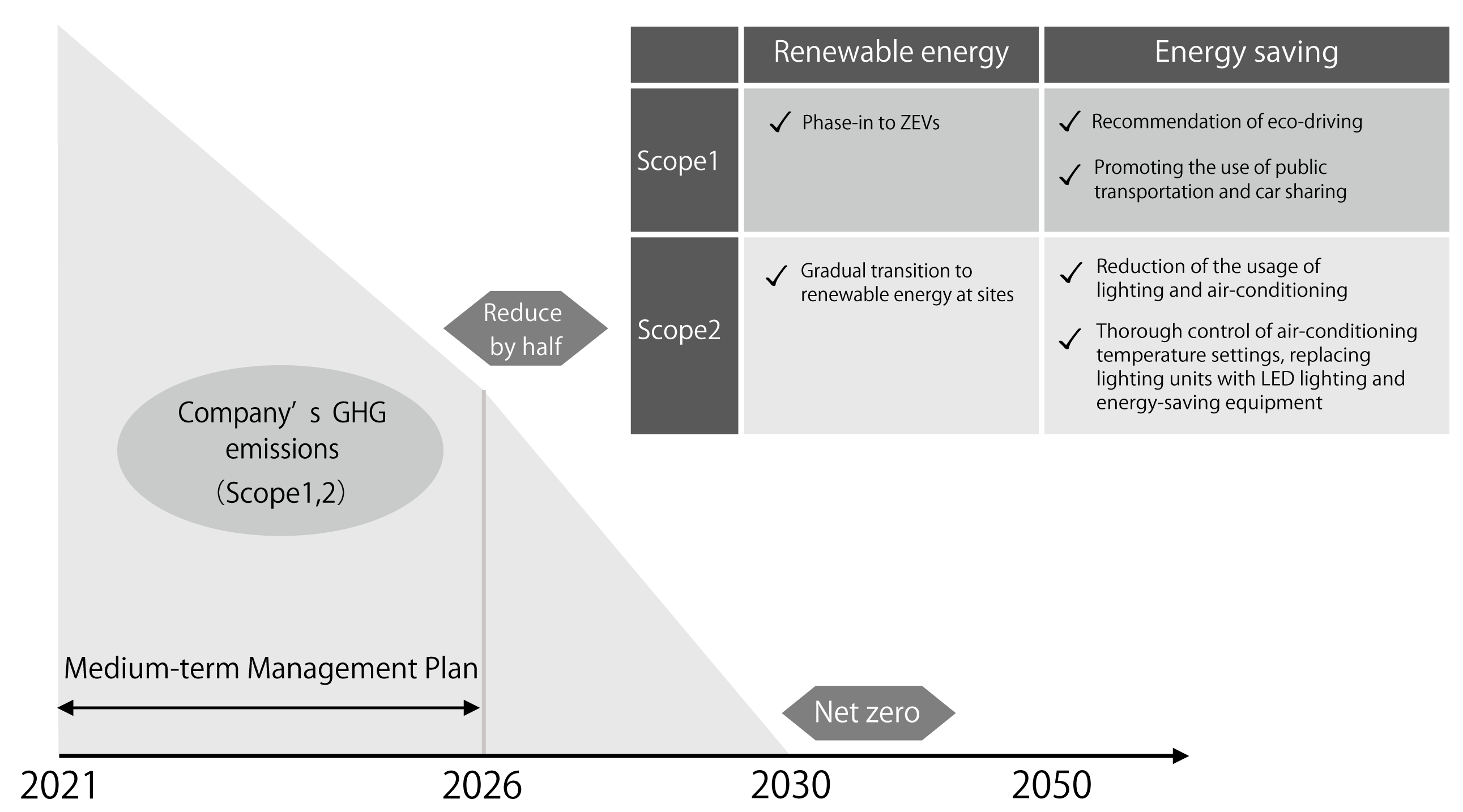
As part of the medium-term management plan “Beyond Our Limits” launched in April 2022, the Group has established “Social Value & Justice” KPIs, including the goal of reducing CO2 emissions associated with our own operations to half (compared to fiscal 2021 actual results) by March 2027 and to net zero by 2030. In addition to the above targets, in December 2022 we formulated the Net Zero Declaration on Greenhouse Gas Emissions, which includes our endorsement of the Paris Agreement adopted in December 2015 and the 2050 Carbon Neutrality Declaration announced by the Japanese Government in October 2020, as well as our contribution to the realization of a carbon-free society through our operations that fulfill the role as a financial service provider. The transition plan will be reviewed as appropriate based on the TCFD and other frameworks, and the Company will promote measures toward the early realization of a carbon-free society.